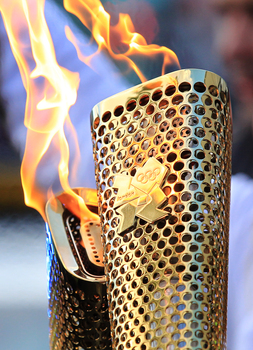
Friday, 20 July 2012

Let’s get it out there!

The Olympics haven’t kicked off yet, but the Games have already made headlines for all the wrong reasons. There was the G4S ‘scandal’, the omission of Becks from the team GB football squad, the ticketing debacle, the allegations against major sponsor adidas of paying “poverty wages” in Asia (which it firmly denies), the decision to allow former ‘drug cheats’ to compete, and so on and so forth.

Now I should probably explain that I am a massive fan of the Olympics. I was lucky enough to be working from home during the Beijing Games, so I managed to catch almost every event (as work-related research, of course). Even sports like hockey, which I detested at school, were fascinating to watch.

There is something incredibly special about having the world’s top athletes all in one place. About the fans travelling from around the world to cheer on their country’s best sportspeople; the face paints, the waving flags and the excitement that exudes from every pore of those watching live.

I’ve heard people complaining about the added security risks in London this summer, the disruption to travel services, and of the cost to the taxpayer. But I wonder whether people would make the same complaints if we were hosting the World Cup… I think the moaners and the groaners have simply failed to capture the thrill of the Games and the absolute privilege it is to have them on our doorsteps.

So here comes the shameless plug… The Olympics version of Sorted magazine is out now, and a number of people (including the mighty Bear Grylls) have said it’s our best issue to date. It covers everything from security to doping and features in-depth, exclusive interviews with Victoria Pendleton, Steve Redgrave, Tom Daley, Philips Idowu, Jessica Ennis and a host of others. It also tells you what’s on (and when) to ensure you don’t miss any key events.

And with all the other content – film reviews, gadgets, nutrition advice and great insights from our regular columnists – you’ll love it even if you’re not a sports buff. In fact, the front cover alone is worth the money!

But even more importantly, we’re giving away 10,000 free copies of Sorted across London in the next week. It will be available in bars, restaurants and tube stations as well as through the usual channels (online, in local newsagents and at WH Smith). Not only does this magazine offer a much more positive build-up to London 2012, it offers an opportunity to share the Christian message with people who might never hear it elsewhere.

The magazine presents relevant, engaging issues from a godly perspective without being in your face or cringey. There are no tambourines or sock-and-sandal combos. It’s a mag you could be read in public without any embarrassment and pass around your friends. And there has never been a better time to get it out there, with 11 million people expected to hit London in the next month.

If you share our vision of reaching people with a positive, God-focused message, then there are various ways you can help. Number one – buy the magazine and tell people about it. Preferably buy a bumper pack of 50 (for just £75) and give them to people in your church/local area/workplace.

Finally, if you’d like to sponsor some copies, we can get the magazine into the hands of even more people this summer. It’s not cheap printing huge quantities of magazines, and as this is our longest ever edition (108 stonking pages), the cost will be significant. But at Sorted we believe that you reap what you sow, and what you sow into this project financially could have eternal consequences.

Contact Steve Legg on steve@sorted-magazine.com to find out how you can get involved. And let’s make this Olympics one to remember for all the right reasons.  

Friday, 13 July 2012

What does it all mean?


Guest blog with Tim Childs


Perhaps people have been pondering that question since the dawn of time; I know I do from time to time anyway. To some people, life means nothing more than having a good time: drinking, laughing, eating good food and doing the things they very much want to do. That doesn’t sound too bad to me, to be honest. 

To someone else, however, life is more than just enjoying themselves; more than pleasure, more than what it is on the surface. I hasten to add that in my own life I’ve been the consummate pleasure seeker and the thinking philosopher. I’m not a holier-than-thou person; in many respects I’m just an ordinary bloke who likes to think about things.

How do we square the mundane world we live in with the Christian reality God wants us to live out? We are in two worlds: the world of secularism, of sport, of pleasure, of strife and competition, the world that is very much out there; and the world we need to live in as Christians, where God’s laws and rules are the things that set us apart from most other people. We are like two people, one pulled in one direction and one pulled in the other. Is this the Christian life and, if so, what are we meant to do about it? How do we live in two realities?

So what does it all mean? Do we ever really think about that? Do we ponder life’s mysteries and hope for answers, even if they never come? Isn’t it part of the human condition to think; to think deeply about who we are, where we come from, how we got here and how everything come into being? We don’t just need to eat, sleep, work and aspire to better things. We’re more than automatons; we need answers – even if they never come.

Are we to somehow ignore the nagging thoughts we have, to bury them conveniently so we can just get on with our usually complicated lives? What are we to make of the questions that need answering? Who can really say? Haven’t wise men and great philosophers, great ancient thinkers and great holy men and women pondered all this long before today? And if they couldn’t come up with any credible answers, if they could make neither head nor tail of it all, why do we think we might be able to?

And how many realities are there? There is the Monday morning reality, there is the reality of the deadline, there is the inevitable reality of being let down by family and friends. There are perhaps as many realities as there are human beings. But, for me, there is the growing reality of God. We can’t ignore Him because He always has a way of making Himself known; through creation, to answered prayer or in the seemingly random twists and turns of fate. We never see His face, but somehow we know we’ve encountered Him, even if we can’t quite put a finger on how.

But does any of it actually mean anything, after all? Where we are going and what we want to do with our lives; will it make any difference? If we’re descended from apes, as some scientists and evolutionists claim, then it really doesn’t mean or amount to anything does it? 


If we are, however, specifically created by a loving God, a creator who has only ever wanted the best for us, where does that leave us? Don’t we have a duty to find out what He wants from us? Whatever you believe, it is obvious that human beings stand apart from the rest of creation. We are special, we are different, we are restless and creative, never satisfied and wanting to push boundaries; it’s the human condition.

For me, becoming a Christian wasn’t the end of my journey, it was in fact the beginning of my journey; the beginning of finding out who I am, what I am about, where I come from and where I am going. It is a journey that involves an intimate relationship with my creator and one that starts anew each day. I still don’t fully know what God has in store for me, but I am eager to find out. It is more than religion, more than fulfilling a set of rituals, far more than being religious (whatever that means). It is a walk with God, a 24/7, day-to-day reality that shapes my life and defines who I am and what I do.

So again, what does it all mean? You know, I don’t have the answer to that question; not fully anyway. But I see light at the end of the tunnel, not darkness but light. If we want to know the answers to the big questions, then who better to ask than He who created us? I still have so many questions, but don’t we all? Question after question assails me, but I know one day I will have all the answers I seek. 

Find out more about life's big questions in the next issue of Sorted magazine.

Thursday, 5 July 2012

Pornography: the elephant in the pew


The internet has made access to porn much simpler: 25% of all search engine queries are related to pornography (that’s 68 million queries a day) and 12% of the websites (24.6 million) available online are pornographic. 

So what’s so wrong about it – I mean it’s not hurting anyone is it?

Well Shaun Parker disagrees. He works with XXX Church, a Christian organisation that aims to help those who struggle with pornography. I asked him why people might be struggling with it and what they can do if they are.

Why is pornography a problem?
Whenever I speak to people who consume pornography and don’t have a problem with it, their biggest excuse is that it’s not hurting anyone.

XXX Church goes to the [pornography] trade shows, and last year I was in Miami at one of the shows. All these porn stars were on the stage and they were having to paint this picture of ‘it’s an amazing industry, we have complete control, we can do whatever we want’. And then as the girls were coming off the stage, you could literally see them crying, because they knew that there would be women that, from hearing those words they were saying, would be interested in joining the industry.

So my first thing would be that if they are consuming porn and they think it’s not hurting anyone, it is hurting people. I receive emails every single day from people who have lost their family, their work, their lives really, as a result of their addiction and consuming pornography. Statistics show that so many people are hooked on it, and so many people have had their lives ruined because of their addiction to it.

What makes it so attractive?
Everywhere you look, sex sells. I think part of it is that advertising has helped sell that really over the years, and from the people I’ve spoken to, it really creates a false reality. We’ve been desensitised to it. We have this idea that sex is like how we see it in the magazines, and then people go to their partners and say “why aren’t you doing this?”

What impact can it have on a relationship?
When I hear about a lot of relationships broken up as a result of pornography, that tends to be the number one reason. It creates a false reality and the man (or the woman) is expecting something that they’re not receiving.

Scientists have proven that porn addiction is like a drug. The chemical you get from consuming pornography is the same as you get from cocaine, I believe.

There is an element of cheating, because obviously they’re being relieved in a way that isn’t from their partner. We get emails from people on the website saying they have a huge problem with guilt, especially when they’re married.

What can be done about it?
Even before I was with XXX Church I was a big believer in accountability software. Not just because it protects me, but also for in the future when I have kids we have a system where you can actually receive messages the instant that someone accesses a website they shouldn’t access.

Are churches in denial about porn?
In America, and I’m sure the statistics are very similar to the UK, half of the male population of the Church would be consuming or addicted to pornography. And then you’ve got women – a third of the women are visiting these websites on a regular basis. It’s one of those things that keeps coming up, but we don’t really want to talk about the elephant in the pew. I think as a church and as a society, we really need to be talking about this issue.

Is it possible for people to be ‘delivered’ of this addiction?
You can definitely be free. We have people working on the XXX Church team that have been free for 10-15 years. You can be free of any addiction, but you have to be aware that that’s always going to be there.

You hear stories of people who are completely delivered; they’ve had one of those moments with God where He just comes and their desire for alcohol or desire for whatever is no more. So I totally believe that can happen, but a lot of people that use our software are recovered addicts that just want to make sure that everything’s covered; that if I have a bad moment, someone will be on my case and can help me out.

I think accountability, in general, is the key for living life.

Read more about Shaun’s work with XXX Church in Sorted September-October.

Sunday, 1 July 2012

What happens when a ‘houseperson’ gets sick?

Guest blog from Michael Clark

I say ‘houseperson’ with reason, because everyone knows women are so much better than men at being sick and managing to work.

My poor mum seemed to manage two jobs (one-parent families in the sixties didn't live the high life on benefits) as well as satisfying her houseproudness, which knew no bounds.

We all know that if men feel rubbish in the morning they just phone up work and say, "I’m sick". Of course, this often involves putting on a very husky voice, mumbling a lot and dropping hints about hideous bodily fluids – just so the boss knows this is the real deal and not just a common case of man flu).

Women have always been able to get themselves to work, and – if they lack the useful househusband appendage – come home cook for the kids, help with homework and so on and so forth.

So really, when I ask what happens when a houseperson is sick, I do mean househusband, because (irritatingly) the housewife just says, "So what?"

This question came to mind today by a lack of chipperness in Bozo when Mrs Bozo's alarm went off. Last night was a late one; Mrs B had spent it at a gala dinner hobnobbing with the great and the good (including the heir to the throne).

My own evening was less jolly, thanks to Spain and Portugal whose promised festival of football turned into a yawn fest. Alan Hansen commented: "Let's give extra time a miss and go straight to penalties – they will at least be exciting...". How right he was!

Anyway, having watched it home alone, I can say with total honesty that there was nothing self-induced about my dawn migraine! Poor Mrs Bozo departed sans tea, and I stayed under the covers with a throbbing head, paracetamol supply and a blackout eye mask. Until, at 10.34, a small voice suggested some tea might help nudge the headache off the radar.

Now it’s 1334, and in three hours I have managed to drink three cups of tea, two large espressos and write a blog and a half. Not bad going!

However...

The kitchen looks like it was cleaned by Al Qaeda. The shopping needs doing, especially as I am cooking for our home group tonight and currently all they have to look forward to is a packet of spaghetti.


So this brings me back to the question... what does the godly househusband do when he is sick?

I suppose it is a big disappointment to read this far and see no magic button to press. But all I can recommend is this...
  • Take it slow
  • Ease into it
  • Don't be shy of painkillers!
  • Commit to achieving key things. After all, if this was a paid job and you were a driven employee, you know if you had a crucial deadline you’d make sure you met it...
  • Well, this is a crucial deadline – not all of it maybe – but some parts of it... So commit to those parts
  • Oh, and last but by no means least, pray, pray, pray because (as in any trial) it is not your strength but HIS that will carry you through.


Read about a full range of men's issues in Sorted magazine.

Tuesday, 26 June 2012

Men and the Church

Special guest blog with Sorted publisher and editor Steve Legg

Being a real bloke in the 21st century is difficult. We suffer with man flu and many of us cried when England were knocked out of Euro 2012. Some men use moisturiser and eat fancy sandwiches with rocket in them. 

My dad knows how to tinker around under a car bonnet and change a wheel on the car. I don’t. I call out the RAC. I’m a disaster at DIY.
But being a Christian bloke is even harder. It seems to me that church these days is mainly geared for a particular type of person. I used to say women, but my wife assures me it's not her cup of tea either. Whoever it's aimed at, men don’t come and that’s a tragedy; because most men don’t want anything to do with the Church.
I think part of the problem is that we run meetings in buildings with embroidered banners and nice flower arrangements. Many men just don’t feel comfortable in that sort of environment with lots of singing, sitting down for ages and listening to long talks in a building that looks like something out of a Laura Ashley showroom. They feel uncomfortable with hugging, holding hands and sitting in circles discussing their feelings in a church context.
We also seem to have turned Jesus into a wimp with a beard. You know the sort of thing: gentle Jesus meek and mild, long flowing hair, blue eyes and wearing a white M&S negligee and sandals. He’d be nice enough to present Songs of Praise alongside Aled Jones, but he wouldn’t turn the world upside-down.
Statistically we’re told that the Church is made up of 70% women and 30% men, with 90% of boys leaving by the time they hit their late teens. I guess church didn’t quite match up to their spirit of adventure and turned out to be less Bruce Willis and more Bruce Forsyth. Men are looking for a challenge; they need the gauntlet to be laid down before them with a strong, motivating message that relates to their everyday life.
Jesus was a man’s man – a powerful, amazing, revolutionary bloke – and the first thing he did when he started his public ministry was to choose a bunch of lads. They weren’t professional, well-spoken good boys; they were a bunch of working class, down-to-earth blokes who constantly put their foot in it. But he chose them to take the gospel to the ends of the earth.
Around 150 years ago, the Industrial Revolution meant many men went off to find work in mills, mines and factories leaving mainly women, older people and children in church, so ministers adapted services to suit the new congregations and church began to change. Add in a bit of Victorian respectability, send the men away again to a couple of World Wars and Bob’s your uncle, but church is no longer a place geared up to meet Bob’s needs!
The wars are over but the men have come back to find a church they don't feel at home in, so they choose to opt out altogether. It’s like going shopping with my wife – I just don’t want to do it.
To get men back and involved, we need to change the way we run church. Men often struggle in a classroom environment so that’s why Jesus didn’t sit them behind desks or hand out study guides. They did stuff together and learned along the way.
Jesus taught Peter how to step out in faith by getting out of a boat and walking on water – not by listening to a CD series, hearing a sermon or watching a documentary on God TV. That should be a valuable lesson for starters.
When it comes to reaching men for Christ, men love doing stuff together – team sports, fishing, pub quizzes, paintballing, DIY projects, curry nights, bowling, clay pigeon shooting and going out for a beer. 

If we build genuine relationships with men through active events we’ll put ourselves in a position to introduce them to a God who never sits still and who is relational to the core.
But I don’t think it’s about trying to create a masculinity that’s more to do with John Rambo than Jesus Christ, because we’re all different and that’s where some churches and men’s groups get it wrong; they forget that although Jesus sat round fires with fishermen, he cried with them too.  
The thing we do have in common is that all men crave warmth, honesty and authenticity. Most are genuinely interested in spirituality, meaning and asking deep questions. They want to know how to become better dads and husbands.
Sorted surveyed hundreds of Christian men and asked them what subjects they’d most like to see tackled in church. Family issues were top, followed by money, anger, sexual purity, addictions, pornography and gambling.
It shows men are looking for answers to important questions, but this doesn’t have to be on a Sunday at 11am in a cold building with a tall steeple. It’s a case of connecting with men where they’re at and showing them that Christianity is worth following, has real answers to tough questions and isn’t just for girls.

Thursday, 21 June 2012

Sorted's golden Olympic dream

As deputy editor of Sorted magazine, I have the privilege of reading every article and piece of text before it hits the pages. 

I also get to see it laid out using all the fancy techniques the design team has at its fingertips. Seeing as I’m not really the artistic type, I’m always impressed when the dry text turns into such eye-catching spreads.

So when I got my first glimpse of the printed Olympic edition a few weeks back I shouldn’t have been surprised at its quality; but I have to say that I was.


I may be a little biased, but I genuinely think it is our best issue yet. It’s packed with stunning images and layouts, but also offers something wholesome and informative that just doesn’t seem to be available from other men’s magazines.

But while it makes for a great read, there’s an even more important reason for it to be such a special edition. Sorted has an Olympic dream to distribute 250,000 copies of its special London Games edition across the capital as a fantastic evangelistic opportunity.

“Our goal is to provide a world-class giveaway and flood London with free copies of our special Olympic edition of Sorted,” said the magazine’s publisher and editor, Steve Legg.

“Our dream is to distribute quarter of a million copies through our innovative network of free distribution points: tube and rail stations, Eurostar carriages, Olympic campsites and tourist locations, including open-topped red buses. Plus free copies in the Athlete's Villages during the 2012 Games.

“The reality is, at this moment in time, we can only do 30,000, but we are believing and praying for support and financial provision to reach our original goal.”

This is the biggest edition ever of the magazine, featuring more than 100 pages and including exclusive interviews with Steve Redgrave, Jessica Ennis, Phillips Iduwo, Rebecca Adlington, Tom Daley and Victoria Pendleton.

Steve believes this edition of Sorted will really complement outreach events taking place this summer: “The London Games is a once in a generation opportunity and is too good to miss. Churches have opportunities to get involved with the national Torch Run, plus showing the Games on big screens at their own premises.

“Sorted is such a high-quality yet non-threatening giveaway that we are making available at super reasonable price (from just £1.25 a copy). Giving a magazine away is the easiest form of evangelism going, yet could have profound results.”

TV adventurer Bear Grylls, who is a regular contributor to the magazine, said: “This is the best Sorted issue ever. It embraces the courage of Olympians and the sort of faith that can help you run like the wind.”

To order your copies of Sorted or to donate to this Olympic outreach opportunity, visit the Sorted website today.

Saturday, 16 June 2012

We could all learn a lot from the Irish

It would be impossible for me to write a blog this week without referencing the Euros – seeing as watching them is about all I’ve done over the last week or so.

There have been thrills, spills and various stomach ills since the tournament kicked off, and there’s plenty more action to come.

But there have also been some pretty unwelcome contributions to the games, primarily from the fans. I was really angered last night to see the behaviour of the England and Sweden fans in Kiev before kickoff.

Riot police and members of the military were called in to keep the two sets of fans apart. The military! How disgusting. And from the footage I saw on Sky Sports News, I’m ashamed to say the English fans seemed to be the more antagonistic of the two sets of supporters.

In other news, Uefa has hit the Russian FA with a £96,000 fine and a six-point deduction in the qualification phases of the next Euros in France. The association was penalised for violence inside the Wroclaw stadium during and after their game against the Czech Republic on June 8, including the assault and battery of match stewards when the final whistle was blown.

Russian and Polish fans are also being investigated for an outbreak of violence in Warsaw on June 12. If found guilty over the fan violence that led to 15 injuries and more than 180 arrests, Russia could find the suspended six-point deduction imposed immediately. (It’s worth bearing in mind that Russia are set to host the World Cup finals in 2018…)

But that’s not all. The Croatian FA has also been fined £20,200 for its supporters' behaviour during Croatia’s game against the Republic of Ireland. Croatian fans let off flares during the 3-1 victory in Poznan on June 10. Stewards also had to tackle a supporter who ran onto the pitch to kiss coach Slaven Bilic.

Uefa is also investigating reports that a banana was thrown on to the pitch during the match between Italy and Croatia on June 14, with monkey chants reported to have been directed at Italy striker Mario Balotelli.

And we all thought Ukraine were going to be the major villains of the contest! With all the attention on the country ahead of the tournament following the BBC Panorama documentary Euro 2012: Stadiums of Hate, many fans decided not to travel to Ukraine; which perhaps explains why some of the stands have looked a little sparse.

Although Ukraine coach Oleg Blokhin accused fair-weather Ukraine fans of "wanting to shoot” the team when they’re not winning, there haven’t been any signs of Neo-Nazism as far as I’m aware.

There were rumours of monkey chants from Polish fans in Krakow while the Dutch team were training, but the Ukrainians seem to have kept themselves relatively under control overall. Maybe last night’s storm stole their thunder!

It is shameful, though, that violence and racism are still making headlines during football competitions (or anywhere else, for that matter). How dare people discriminate against others based on the colour of their skin or where they were born? And how dare people allow a bit of friendly football banter to bubble over into ‘patriotic’ fisticuffs.

I appreciate that people want their national teams to win and are disappointed when they don’t, but this disgusting behaviour needs to be stamped out, and hard. Let’s introduce lifetime bans for racist fans and hooligans. And let’s threaten to impose proper fines against teams who break the rules.

Maybe we could all learn something from the Irish supporters (and I’m not talking about how to drink many, many pints of beer). I really admired the way the fans in green got behind their team, even when their players underperformed.

Yes, they were the first team to be booted out of the tournament, but the fans were a pleasure to watch; in the stands as they sang their hearts out; and on the streets, where good-natured celebrations continued. They may not have won any silverware this time round, but the Ireland team should be proud of the way their fans have conducted themselves throughout. 

Read more from Joy in the next issue of Sorted magazine.